You Are Here: Home > NEWS > Oil Purifier Technology
Writer: Kaiqian Oil Purifier Release time:2026-10-26 11:50 Clicks:
When an oil purifier does not remove water as expected, the cause is not necessarily a failed machine. Dehydration performance depends on the type of water in the oil, the oil temperature and viscosity, the vacuum and sealing condition, the treatment flow, the initial moisture level, and whether the selected purification process matches the oil and contamination state.
Before adjusting the machine, identify whether the oil contains free water, emulsified water or dissolved water. These forms of moisture behave differently during treatment. A filter element designed mainly for particle removal cannot be expected to remove dissolved water, while a vacuum oil purifier may require suitable temperature, sufficient residence time and a stable vacuum environment to achieve effective dehydration.
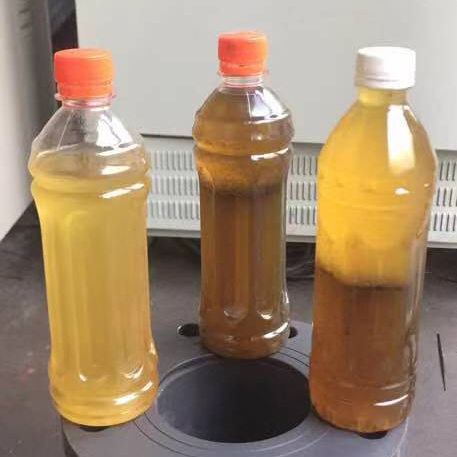
Free water settles at the bottom of an oil tank, appears as visible droplets or collects in low points of the circulation system. It may be removed through draining, settling, coalescing separation or an appropriate dehydration stage. If the oil tank, pipeline or purifier inlet contains a large quantity of free water, the equipment may need pre-drainage before normal circulation treatment.
Emulsified water is dispersed into small droplets and remains suspended in the oil. The oil may look cloudy or milky, and the water may not separate after standing. Emulsification can be caused by agitation, surfactants, degraded additives, contamination or unsuitable operating conditions. Simple mechanical filtration generally does not solve this problem. The treatment process may require controlled heating, coalescing separation, vacuum dehydration or other measures selected according to the oil type.
Dissolved water is not visible as droplets and may not make the oil appear cloudy. It can be present in transformer oil, turbine oil, hydraulic oil and lubricating oil even when the oil looks clear. Vacuum dehydration is commonly used to reduce dissolved moisture, but actual results depend on vacuum stability, oil temperature, viscosity, contact area and treatment time.
A particle filter removes solid contaminants but does not directly remove dissolved water. A water separator may perform well with free water but be less effective against stable emulsions. A vacuum oil purifier is more suitable when the treatment target includes dissolved moisture and, in some applications, dissolved gases, but it still cannot restore oil that has suffered irreversible chemical degradation.
For this reason, “the oil has passed through the purifier” does not automatically mean that the water content has reached the required level. The process configuration should be selected according to the oil type, equipment application and measured moisture condition.
Oil temperature affects viscosity, flow resistance and the release of moisture under vacuum. If the oil is too cold, high viscosity can reduce circulation and weaken mass transfer in the vacuum chamber. If the oil is overheated, the oil itself, additives or insulation materials may be adversely affected.
The appropriate operating temperature should be determined from the oil manufacturer’s requirements, equipment design and site safety conditions. Heating should be stable and controlled rather than increased simply to accelerate treatment.
Vacuum dehydration depends on the pressure and operating stability inside the treatment chamber. A leaking vacuum line, damaged seal, blocked exhaust path, contaminated vacuum pump oil or poor pump condition can prevent the system from maintaining the required vacuum environment.
Check the vacuum reading during continuous operation instead of relying only on the value displayed during an unloaded test. Inspect the vacuum hoses, valves, chamber seals, sight glasses and flanges. If the vacuum pump is running but the pressure does not change as expected, the problem may be related to leakage, pump performance, valve position or excessive vapor load.
The rated flow of an oil purifier is not the same as the time required to achieve a moisture target. Actual treatment performance is influenced by the oil volume, initial water content, viscosity, temperature, vacuum condition and required final quality. Increasing the flow may reduce the effective residence time in the dehydration chamber.
For heavily contaminated oil, continuous circulation at the nameplate flow may not produce the expected result in a short period. The treatment plan should allow sufficient circulation time and include intermediate sampling. A purifier should be evaluated by its ability to reach the required oil condition, not only by its nominal throughput.
Large quantities of water, sludge or solid particles can rapidly load the pre-filter and affect oil circulation. A pressure increase across the filter, reduced flow, unstable operation or repeated alarm may indicate that the element needs inspection or replacement.
An overloaded filter can also cause bypass or force operators to reduce operating controls. Check the differential pressure, filter element condition, drain system and water collection chamber. Removing bulk water and heavy solids before fine purification may improve the stability of the entire treatment process.
Even if the purifier removes moisture correctly, water can re-enter the oil through open tank covers, poorly sealed sampling points, wet hoses, unclean storage containers or humid ambient air. Transformer oil and other insulating oils are particularly sensitive to exposure during filling, storage and maintenance.
Keep the oil circuit closed as far as practical. Use clean and dry hoses, tanks and sampling containers, and inspect the breathing or sealing arrangements of the oil storage system. If the moisture content rises again soon after treatment, investigate the equipment and storage environment instead of repeatedly extending purification time.
Water may not be uniformly distributed in a tank, especially when free water has settled or the oil has not been circulated sufficiently. A sample taken from the surface may not represent the oil at the tank bottom or the oil entering the purifier.
Use clean, dry sampling equipment and define consistent sampling points. Compare samples taken before treatment, during circulation where necessary, and after the oil has been mixed adequately. The testing method should match the application and the type of moisture being assessed. Visual clarity alone cannot confirm that dissolved water has been removed.
Confirm the oil and equipment application. Determine whether the oil is transformer oil, turbine oil, hydraulic oil, lubricating oil or another product. The acceptable moisture condition and treatment method may differ.
Review the contamination condition. Check for free water, cloudy or emulsified oil, solid particles, sludge, abnormal odor, viscosity change and evidence of oxidation. Do not classify every abnormal appearance as a water problem.
Inspect the inlet oil and tank. Drain settled water where appropriate, check the tank bottom and confirm that the storage container and hoses are dry and clean.
Verify operating conditions. Record oil temperature, inlet and outlet pressure, flow condition, vacuum behavior, heating status and the operating time. A single displayed parameter cannot represent the complete dehydration process.
Inspect the vacuum and filtration components. Check vacuum pump oil, seals, valves, hoses, exhaust path, filter elements, differential pressure and automatic drain operation.
Take representative samples. Compare test results before and after treatment using the same sampling method. For transformer oil, moisture content should be assessed together with relevant dielectric performance rather than by appearance alone.
Evaluate the result against the actual service requirement. A lower water content may be necessary for high-voltage insulating oil than for some general lubrication applications. The target should be confirmed from equipment requirements, oil specifications and applicable testing procedures.
Persistent cloudiness may be related to stable emulsion, fine particles, oxidation products, additive incompatibility or oil aging. Vacuum dehydration can reduce water under suitable conditions, but it does not restore consumed additives, reverse all oxidation products or repair chemical degradation.
For aged turbine oil, hydraulic oil or lubricating oil, inspect moisture, particle cleanliness, viscosity, acid value and other application-specific indicators. For transformer oil, moisture content should be considered together with breakdown voltage and other relevant electrical tests. Oil color and transparency are useful visual clues, but they are not sufficient criteria for deciding whether the oil can continue in service.
Remove settled free water before starting long-duration circulation treatment.
Use a purifier process suitable for the oil type and the form of water present.
Operate within the recommended temperature range instead of using excessive heating.
Maintain a stable vacuum and repair leakage before evaluating dehydration efficiency.
Reduce the treatment load or extend circulation time when the oil has high initial moisture, high viscosity or severe contamination.
Replace overloaded filter elements and keep the water drainage system functional.
Prevent secondary moisture ingress through dry hoses, sealed tanks and controlled sampling.
Confirm treatment results with laboratory or field testing appropriate to the oil application.
Before purchasing an oil purifier, provide the supplier with the oil type, total oil volume, equipment application, initial test results, expected moisture condition, viscosity range, particle contamination, operating environment and required treatment objective. If the oil is transformer oil, also clarify whether the project requires moisture reduction, particle filtration, degassing, vacuum oil filling or a combination of these functions.
During technical clarification, distinguish between rated flow, circulation capacity and the time required to reach the target condition. Ask how the proposed system handles free water, emulsified water and dissolved water, and confirm the sampling and acceptance method. A suitable oil purifier should be selected from verified oil data and operating conditions, not from flow rate alone.
Poor dehydration performance is usually a result of a mismatch between contamination state, process conditions and equipment configuration. A systematic check of the water form, vacuum system, temperature, flow, filtration stage, sealing condition and test method will help determine whether the problem is operational, maintenance-related or caused by unsuitable equipment selection.
Address:No.66 Kecheng Road,Jiulongpo District, Chongqing, China
Phone:0086 13983031725
Whatsapp:0086 13983031725
Email:oilpurification@kaiqiancq.com