You Are Here: Home > NEWS > Oil Purifier Technology
Writer: Kaiqian Oil Purifier Release time:2026-11-10 14:17 Clicks:
Safe and effective oil purifier operation depends on more than starting the pump and passing oil through a filter. The oil type, contamination condition, treatment objective and purifier configuration must be matched before operation. A vacuum oil purifier may remove water, gases and suspended particles under suitable conditions, but it cannot restore severely oxidized oil or remove every dissolved contaminant.
The correct operating method should therefore begin with process identification and end with quality verification. Operators should not judge treatment performance only by oil color, transparency or the apparent cleanliness of a filter element.
Different oils require different treatment methods. Transformer oil commonly requires dehydration, degassing and fine particle removal because moisture and gas affect insulation performance. Hydraulic oil and turbine oil may require particle filtration and free-water removal, while lubricating oil may also contain oxidation products, additive degradation products or sludge that cannot be eliminated by ordinary filtration alone.
Before connecting the purifier, identify the oil source, approximate volume, operating history and known contamination. Confirm whether the purpose is oil recovery for continued use, routine maintenance filtration, moisture removal or preparation for further processing. If the oil is intended for regeneration into base oil or conversion into fuel oil, a conventional oil purifier should not be treated as a substitute for a distillation or refining process.
Inspect the purifier, hoses, valves, filters, electrical system and control instruments before introducing oil. The inlet and outlet hoses should be connected to the correct ports, firmly secured and suitable for the oil temperature and operating pressure. Hose connections must be clean because a small amount of dirt introduced during installation can affect the treated oil or block a fine filter.
Check the oil level and condition of the vacuum pump lubricant where applicable.
Confirm that the filter elements are correctly installed and that their sealing surfaces are clean.
Inspect the vacuum chamber, sight glasses, drains and oil collection points for leakage.
Verify that the power supply, grounding and emergency stop functions are available.
Confirm valve positions before starting the feed pump and vacuum system.
Make sure the receiving tank has sufficient capacity and is clean and dry.
For transformer oil work, avoid exposing open hoses, tanks and connections to rain, dust or humid air. If the purifier is connected to an energized transformer, the operating procedure must also follow the site electrical safety requirements and the equipment manufacturer’s instructions.
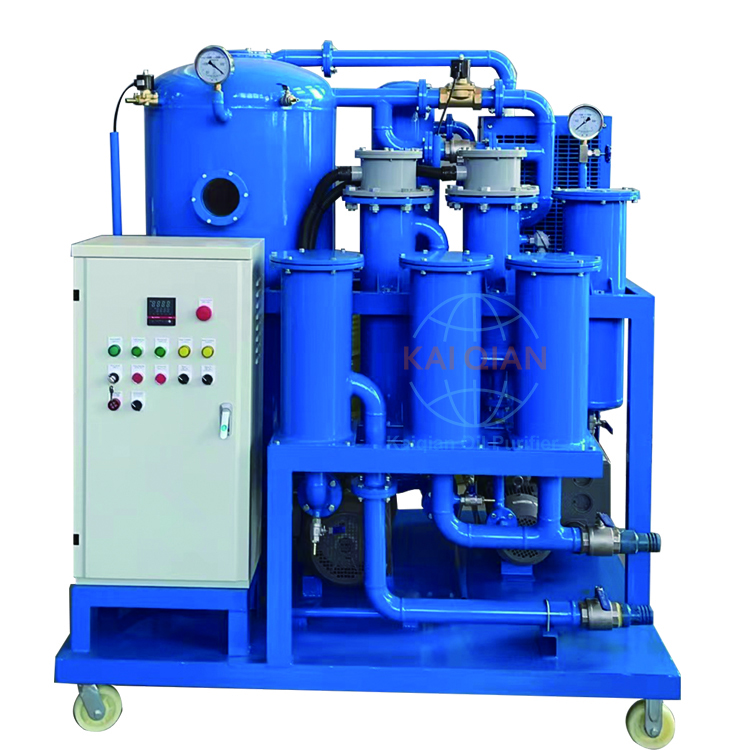
Starting the feed pump at full capacity can cause pressure fluctuations, filter blockage, foaming or unstable vacuum conditions. A safer procedure is to start the system at a low flow rate, confirm that oil is moving through the intended circuit, and then increase the flow gradually within the equipment’s rated operating range.
Operators should observe inlet pressure, outlet pressure, vacuum level, oil temperature, flow stability and abnormal noise. A vacuum reading alone does not prove that dehydration or degassing is effective. The actual result also depends on oil temperature, residence time, chamber design, leakage condition, water load and the condition of the vacuum pump.
Heating can reduce oil viscosity and improve the separation of water and dissolved gases, but excessive heating may accelerate oxidation, damage additives or create unsafe vapors. The suitable temperature is determined by the oil type, contamination condition and purifier design; it should not be selected simply because a higher temperature appears to increase processing speed.
Temperature should rise steadily and remain stable during operation. If the oil begins to foam heavily, darkens rapidly, develops an unusual odor or causes unstable vacuum operation, reduce the heating load and investigate the cause. Water-rich oil, detergents, degraded additives and air leakage may all contribute to foaming.
Filter elements remove suspended particles, but they have a limited dirt-holding capacity. A rapid increase in differential pressure usually indicates high solids loading, unsuitable filter fineness, excessive flow or a partially blocked element. Continuing operation under excessive differential pressure may reduce flow, damage seals or cause contaminants to bypass through a damaged element.
Replace or clean filter elements according to the manufacturer’s procedure and the actual pressure condition. Do not assume that a new filter will solve a problem caused by emulsified water, dissolved contaminants or chemical degradation. If the oil remains cloudy after filtration, check for emulsified moisture, fine particles, oxidation products, additive incompatibility and insufficient separation conditions before concluding that the purifier has failed.
Shared hoses, tanks and filter housings can transfer residues between transformer oil, hydraulic oil, turbine oil and other products. Cross-contamination may change oil properties even when the transferred quantity is small. Dedicated oil-contact components are preferable when the treated oils have different performance requirements.
When shared equipment is unavoidable, establish a cleaning and flushing procedure based on the previous oil, the next oil and the required cleanliness level. Drain residual oil from low points and do not return flushing liquid to a clean storage tank unless its composition and condition have been verified.
Do not stop the purifier by cutting power while oil remains in a heated vacuum circuit unless an emergency condition requires it. A controlled shutdown normally includes reducing the feed rate, stopping heating at the appropriate stage, allowing the system to discharge or drain oil as specified, and then stopping the vacuum and circulation equipment in the correct sequence.
After shutdown, inspect for leaks, unusual deposits, filter blockage and water accumulation. Drain separated water and sludge safely, record operating conditions and identify any abnormal changes. The vacuum pump, heater, filter housing and seals require periodic inspection because poor maintenance can reduce purification performance even when the main unit appears to run normally.
Treated oil should be sampled from a clean sampling point after the system has stabilized and the oil has circulated sufficiently. The required tests depend on the oil and application. For transformer oil, moisture, breakdown voltage, dielectric loss, acidity, particle condition and other relevant properties may need evaluation. For hydraulic or turbine oil, particle cleanliness, water condition, viscosity and evidence of oxidation may be more important.
One test result should not be used to declare the oil fully qualified. Clear appearance does not prove low moisture, and high breakdown voltage alone does not confirm that all oil properties meet the equipment requirement. Compare test results with the applicable equipment specification, maintenance procedure or laboratory assessment before returning the oil to service.
Using a standard filter unit to treat oil that requires distillation, chemical regeneration or other advanced processing.
Increasing temperature or flow beyond the recommended range to shorten processing time.
Ignoring vacuum leakage because the pump is still running.
Continuing operation despite high filter differential pressure or unstable flow.
Mixing different oil types without checking compatibility and contamination risks.
Judging purification quality only by color, transparency or the appearance of the filter element.
Returning treated oil to service without representative sampling and suitable testing.
The most reliable operating practice is to treat the purifier as part of an oil management process rather than as an isolated machine. Correct oil identification, controlled operating conditions, disciplined maintenance and objective post-treatment testing are all necessary to obtain a useful and repeatable result.
Address:No.66 Kecheng Road,Jiulongpo District, Chongqing, China
Phone:0086 13983031725
Whatsapp:0086 13983031725
Email:oilpurification@kaiqiancq.com