You Are Here: Home > NEWS > Oil Purifier Technology
Writer: Kaiqian Oil Purifier Release time:2026-11-13 15:03 Clicks:
Waste engine oil refining is not the same as simple oil filtration. Filtration can remove suspended solids, while true refining requires processes such as pre-treatment, dehydration, atmospheric or vacuum distillation, and residue treatment. The correct process depends on whether the target is recovered base oil, fuel oil, or another intermediate product.
Used engine oil may contain water, metal particles, carbon deposits, degraded additives, fuel dilution, oxidation products and heavy residues. These contaminants are not all removable by one machine. A filter mainly captures solid particles; a dehydration unit removes free or emulsified water under suitable conditions; distillation separates oil fractions according to volatility and thermal behavior.
Changing the oil color does not prove that its performance has been restored. Recovered oil must be tested for properties such as viscosity, water content, flash point, acidity, ash, carbon residue and other indicators required for its intended use. If the oil does not meet the specification for lubricant base oil, it should not be described as finished lubricating oil.
Collection and settling: Keep different waste oils separated when possible and allow large water and sludge particles to settle before processing.
Pre-filtration and dehydration: Remove coarse solids and water to reduce load on the heating and distillation systems. This stage is not a substitute for complete refining.
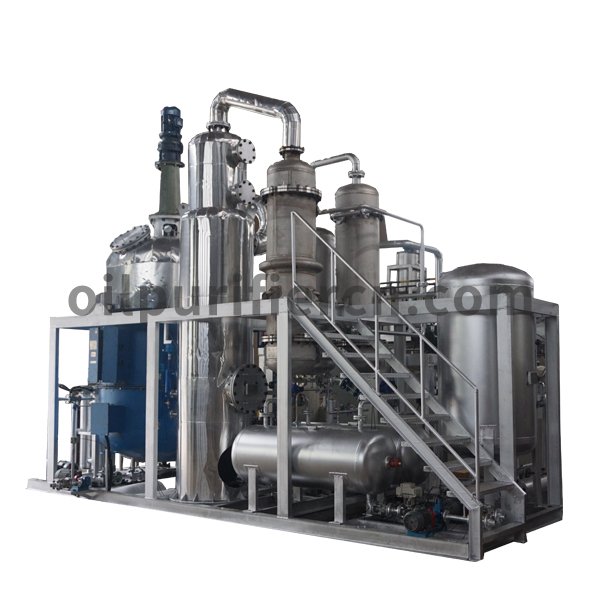
Distillation: Use controlled heating and, where appropriate, vacuum conditions to separate water, light hydrocarbons, usable oil fractions and heavy residues. Vacuum operation can help lower the required boiling temperature and reduce excessive thermal cracking.
Fraction treatment: The separated fraction may require further filtration, adsorption, clay treatment or other polishing steps, depending on the quality target.
Quality verification: Test the finished fraction before deciding whether it can be used as a base-oil feedstock, industrial fuel, or another permitted product.
A waste oil distillation plant designed for base oil recovery needs tighter control of separation, product quality and residue handling. The recovered fraction is a feedstock or intermediate unless it has been further treated and verified against the applicable lubricant standard. Producing fuel oil has a different quality objective and does not mean the product is equivalent to diesel fuel.
Diesel, fuel oil and recovered base oil should not be confused. Diesel is a regulated finished fuel with defined requirements. Waste oil refining may produce a combustible oil fraction, but its suitability for engines or burners depends on composition, testing and local regulations. Equipment selection should therefore start with the required product specification rather than the appearance of the feedstock.
Environmental performance depends on the complete system, not only the distillation vessel. The plant should include closed oil transfer lines, condensers, suitable gas treatment, leak control, sludge collection and safe storage for separated water and heavy residues. Non-condensable gases and vapors should be managed according to local emission requirements, and the operator should prevent untreated waste liquid from entering soil or drainage systems.
Before purchasing equipment, confirm the feedstock type, daily processing quantity, water and sludge content, desired product, heating method, available utilities and local environmental requirements. Ask the supplier to distinguish filtration capacity from distillation capacity and to identify which components are consumables, which residues require disposal, and which product tests are needed after treatment.
.jpg)
Check whether the system is intended for filtration, dehydration, distillation, or a combined process.
Confirm that the material compatibility of tanks, pumps, seals and piping matches used engine oil and its additives.
Review temperature control, vacuum protection, pressure relief and automatic shutdown functions.
Require a clear route for water, sludge, heavy residue and off-gas treatment.
Evaluate product quality using laboratory analysis instead of color or short-term visual inspection.
Verify operating procedures, maintenance access, spare filter elements and operator safety training.
In practice, a suitable waste engine oil refining system is one that matches the feedstock and final product specification while controlling emissions and residual waste. Filtration is useful as a pre-treatment or polishing step, but it cannot replace distillation when the objective is to separate degraded oil fractions and recover a usable product.
Address:No.66 Kecheng Road,Jiulongpo District, Chongqing, China
Phone:0086 13983031725
Whatsapp:0086 13983031725
Email:oilpurification@kaiqiancq.com