You Are Here: Home > NEWS > Oil Purifier Technology
Writer: Kaiqian Oil Purifier Release time:2026-11-13 15:04 Clicks:
Online turbine oil filtration equipment is used to remove suspended particles, sludge and other solid contaminants from turbine lubricating oil while the oil system remains in service. It is suitable for power plants that need continuous oil cleanliness control without draining the entire oil tank. However, ordinary filtration does not remove all dissolved water, gases, oxidation products or chemical degradation, so the equipment must be selected according to the actual oil problem.
In an online or bypass filtration arrangement, a controlled portion of turbine oil is drawn from the lubrication system, passed through filter elements and returned to the oil tank or circulation line. This process can gradually reduce particles generated by wear, dust entering the system, corrosion products and some suspended sludge. The treatment effect depends on the filter rating, oil viscosity, flow rate, contamination level and system design.
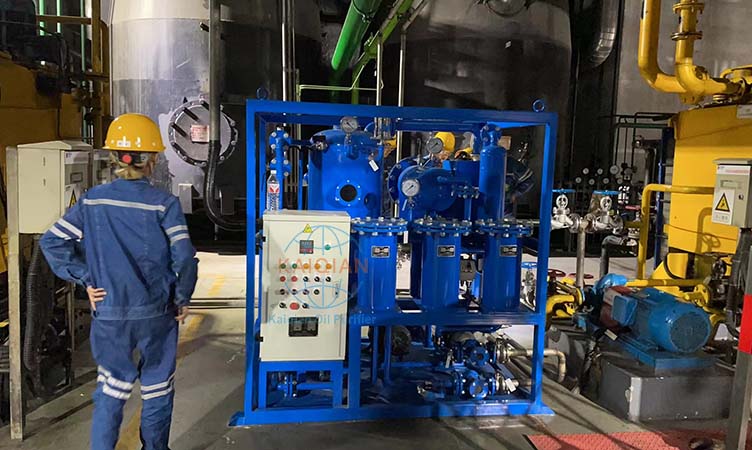
Online filtration is mainly a cleanliness-control method. It should not be confused with turbine oil regeneration or distillation, which are used for more serious oil deterioration and involve different treatment objectives.
Suspended particles: Filtration is suitable when oil analysis shows solid contamination or a rising particle count.
Sludge or deposits: A suitable filter stage may capture loose, insoluble deposits, but heavily contaminated oil may require pre-cleaning and frequent element inspection.
Routine cleanliness maintenance: Continuous low-rate treatment can help control contamination entering the oil system during normal operation.
If the main problem is free water, emulsified water or dissolved moisture, a simple particle filter is not enough. A vacuum dehydration unit or another water-removal process may be required. If the oil has a high acid value, poor oxidation stability, severe varnish formation or other chemical degradation, filtration alone cannot restore its original performance.
Start with the turbine oil type, the oil tank volume, the available connection points and the operating condition of the lubrication system. The equipment should be compatible with the oil viscosity and materials used in the system, and its process flow should not cause excessive pressure loss or interfere with the main oil supply.
Contaminant type: Select particle filtration for solid contamination; consider vacuum dehydration when water is also present.
Filter configuration: Multi-stage filtration can combine coarse protection with finer particle removal, provided the pump and housing can support the required pressure.
Bypass protection: A differential-pressure indicator or alarm helps identify a loaded filter element before flow is seriously restricted.
Installation method: Confirm suction, return, isolation, drainage and electrical connection requirements before purchase.
Maintenance access: The filter housing should allow safe element inspection, cleaning or replacement without unnecessary downtime.
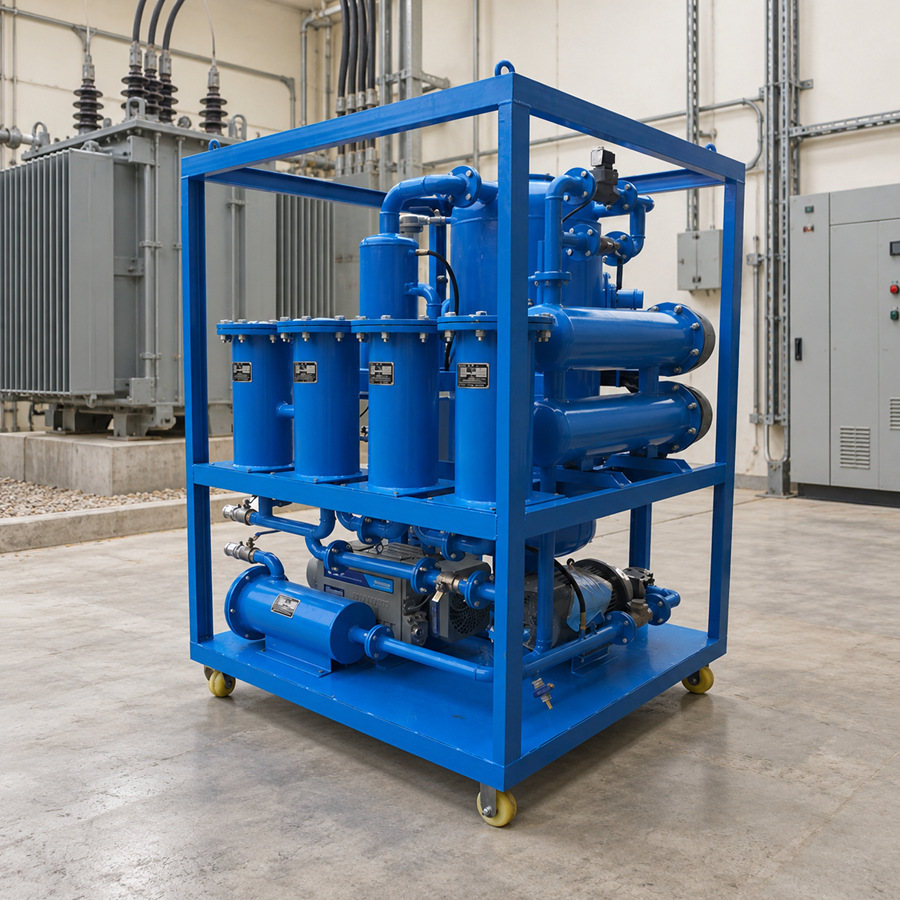
Do not judge turbine oil quality only by whether the oil looks clearer. Visual appearance may improve while fine particles, moisture, acidity or oxidation products remain outside the required range. Before and after treatment, use representative oil samples and compare the indicators relevant to the plant’s oil management procedure, such as particle contamination, water content, viscosity and acid number.
Sampling location and method are important because oil taken from the tank surface may not represent the condition of the circulation line. Operators should also record filter differential pressure, flow condition, operating hours and element replacement history. These records help distinguish equipment performance problems from new contamination entering the turbine system.
Before starting the equipment, check oil compatibility, valve positions, hose and flange sealing, filter element condition and the availability of a safe return path. During operation, monitor pressure, flow, abnormal noise, leakage and any alarm from the control system. If the filter becomes blocked or the system shows abnormal pressure, stop or isolate the unit according to the operating procedure instead of forcing continued operation.
For power plants, the most practical choice is not necessarily the equipment with the finest nominal filter rating. It is the system that matches the turbine oil condition, maintains stable circulation, protects the lubrication system and provides a clear maintenance method. Oil analysis should be used together with online filtration, and additional dehydration or oil treatment should be considered when the contamination is not limited to suspended solids.
Address:No.66 Kecheng Road,Jiulongpo District, Chongqing, China
Phone:0086 13983031725
Whatsapp:0086 13983031725
Email:oilpurification@kaiqiancq.com