You Are Here: Home > NEWS > Oil Purifier Technology
Writer: Kaiqian Oil Purifier Release time:2026-11-16 10:03 Clicks:
Excessive water content in turbine oil should not be treated simply by replacing or repeatedly filtering the oil. The correct solution depends on whether the water is free, emulsified, dissolved or continuously entering the lubrication system. A suitable turbine oil purifier can remove water under appropriate operating conditions, but the treatment process must be matched with the oil condition, contamination source and required quality target.
Water reduces the lubricating performance of turbine oil and can accelerate oxidation, rust and corrosion of metal surfaces. It may also promote additive depletion, oil degradation and the formation of sludge or emulsions. In turbine and hydraulic lubrication systems, water contamination can reduce the reliability of bearings, gears, control valves and other precision components.
The risk is not determined only by the water concentration shown in one laboratory report. Operating temperature, load, oil circulation, equipment design and the location where the sample was taken all affect the actual danger. A result from a bottom drain, an online sampling point and an oil purifier outlet may represent different conditions, so the sampling method must be controlled before deciding on treatment.

Water in turbine oil may exist in several forms. Free water separates from the oil and may accumulate in the tank bottom or low points of the system. Emulsified water is dispersed into small droplets and may make the oil appear cloudy. Dissolved water is held within the oil and may not be visible, even when the total moisture level is already high.
Common sources include condensation during shutdown, leaking oil coolers, damaged tank breathers, humid air entering through seals, poor storage practices and water introduced during maintenance or flushing. If the source remains active, a single purification cycle may only produce a temporary improvement. Source control is therefore part of the solution, not an optional maintenance step.
Inspect oil coolers, heat exchangers and water-side pressure conditions for possible leakage.
Check tank covers, breathers, seals and access openings for moisture ingress.
Review shutdown periods, ambient humidity and temperature changes that may cause condensation.
Check whether water, cleaning fluid or unsuitable new oil was introduced during maintenance.
Examine tank bottoms, dead zones and drain points where free water may remain.
Before operating a turbine oil purifier, take representative samples from the relevant parts of the system. If free water is present, drain it from the lowest practical point before circulating the oil. Samples should be collected in clean, dry containers, labeled with the sampling location and time, and protected from atmospheric moisture during transport and testing.
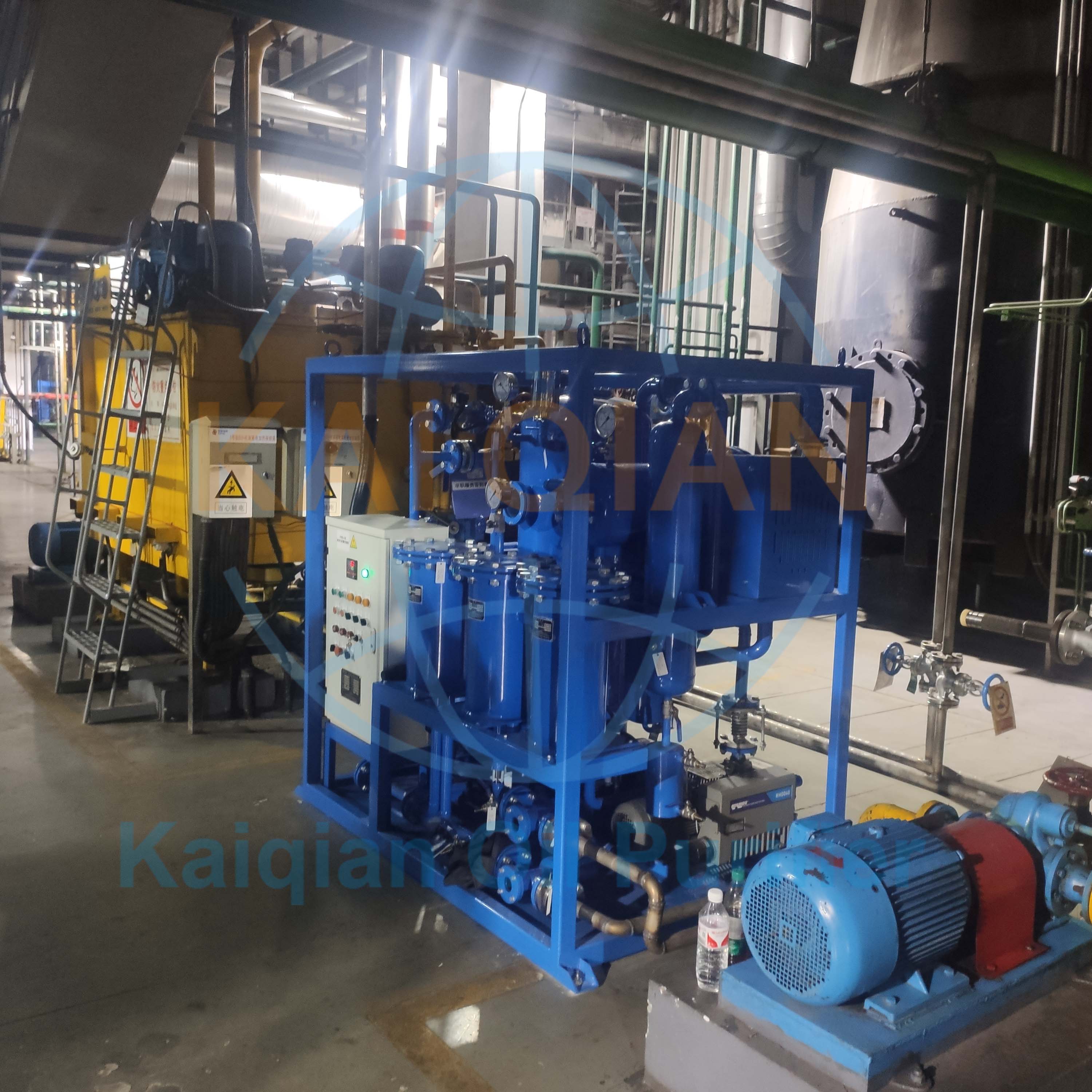
A single visual inspection is not sufficient. Clear oil does not prove that the moisture content is acceptable, and cloudy oil does not by itself define the complete contamination condition. Water testing should be performed with a suitable laboratory method, while the oil should also be checked for signs of oxidation, sludge, particles or additive degradation when these factors may affect reuse.
Gravity draining or settling is useful when a separate layer of free water has accumulated in the tank. It is simple and should often be performed before fine purification, but it cannot normally remove dissolved water or stable emulsions. Continuing to circulate free water without first draining it may increase the load on the purifier and spread contamination through the system.
Coalescing or water-separation filtration may be suitable when the main problem is free or dispersed water that can be separated mechanically. Its effectiveness depends on droplet size, oil viscosity, flow conditions and the design of the separation stage. Ordinary particle filtration should not be regarded as a dehydration process, because a standard filter element mainly captures solid particles rather than water dissolved in oil.
Vacuum dehydration is generally more appropriate when the oil contains dissolved or emulsified moisture. Under suitable vacuum, temperature and flow conditions, water can be vaporized and removed from the oil. The actual performance depends on the vacuum level, sealing condition, oil temperature, viscosity, residence time and initial moisture content. A vacuum oil purifier cannot correct an active water leak or restore oil that has already suffered severe chemical degradation.
Heating can reduce oil viscosity and help water separation or evaporation, but excessive temperature may accelerate oxidation or affect sensitive additives. The operating temperature must therefore follow the oil characteristics and the equipment operating instructions. Higher temperature is not automatically equivalent to better dehydration.
When dehydration performance is poor, check the complete process rather than focusing only on the vacuum pump. Insufficient vacuum, air leakage, a blocked filter element, excessive treatment flow, unsuitable oil temperature or an overloaded water-removal stage can all reduce the result. A damaged seal or improperly closed valve may also prevent the system from maintaining stable operating conditions.
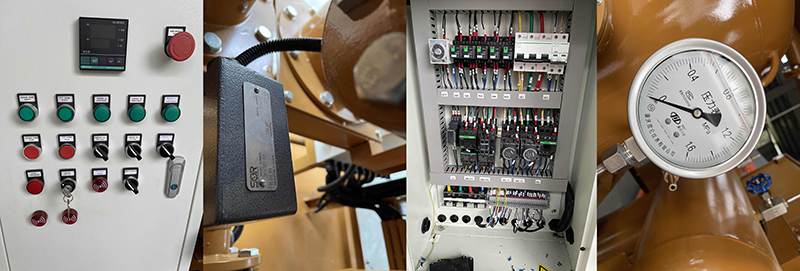
Verify that the oil type and viscosity are compatible with the purifier and process temperature.
Confirm that the vacuum system reaches and maintains the required operating condition shown by the actual machine instruments.
Check for air leakage around covers, valves, pipe joints, sight glasses and other vacuum-side connections.
Inspect differential pressure and flow conditions to determine whether filter blockage is restricting treatment.
Prevent excessive feed flow when the oil needs longer residence time for water removal.
Make sure the water discharge path is open and that separated moisture is not returning to the oil circuit.
Turbine oil dehydration is a purification and maintenance operation. It is intended to reduce water and, depending on the equipment configuration, remove suspended particles and some gases. It does not automatically restore depleted additives, reverse severe oxidation, remove every dissolved degradation product or convert used oil into new lubricant.
If the oil has high acidity, serious sludge, persistent varnish, abnormal viscosity or other evidence of chemical deterioration, dehydration alone may not be sufficient. The decision to continue purification, use additional treatment or replace the oil should be based on laboratory results and the equipment manufacturer's oil requirements. Water removal should not be used to justify continued operation of oil that has already lost its required performance.
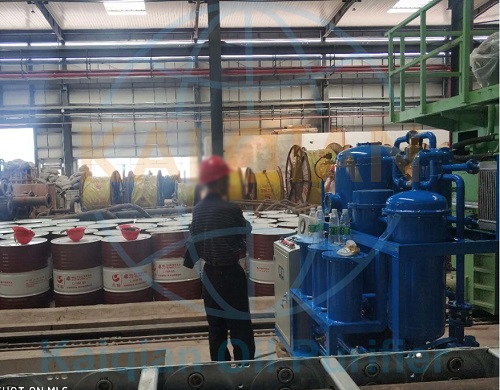
After purification, allow the system to reach a stable circulation condition before taking the final sample. The sample should be collected from a representative point downstream of treatment or from the operating system, according to the maintenance procedure. If the result is still above the target, compare the inlet and outlet results and check whether water is being reintroduced from the equipment.
Post-treatment verification should include the moisture result and, where relevant, particle contamination, appearance, acidity, viscosity and evidence of oxidation. The exact acceptance target must come from the turbine manufacturer, lubricant supplier, maintenance specification or applicable internal standard. Water content should not be judged by color or transparency alone.
Stop or reduce the source of water ingress where safe to do so.
Drain free water from tank bottoms and low points.
Confirm the contamination level using representative sampling.
Determine whether the water is free, emulsified or dissolved.
Select settling, separation filtration, vacuum dehydration or a combined process according to the condition.
Operate the purifier within its actual flow, temperature, vacuum and filtration limits.
Recheck the treated oil and investigate any rapid return of moisture.
The most reliable solution for excessive water in turbine oil is a combination of source control, correct sampling, suitable dehydration and post-treatment verification. A turbine oil purifier can be an effective tool, but its result is determined by the relationship between oil condition, equipment capability and operating practice. Matching the process to the actual contamination mechanism is more important than selecting a machine by nominal flow rate alone.
Address:No.66 Kecheng Road,Jiulongpo District, Chongqing, China
Phone:0086 13983031725
Whatsapp:0086 13983031725
Email:oilpurification@kaiqiancq.com