You Are Here: Home > NEWS > Oil Purifier Technology
Writer: Kaiqian Oil Purifier Release time:2026-11-16 10:13 Clicks:
The time required for a vacuum oil purifier to process one ton of oil cannot be determined from the oil volume alone. The main reference is the machine’s actual processing flow under the specific oil type, viscosity, contamination level and treatment objective. A unit with a nominal capacity of 3,000 liters per hour may not process one ton in exactly 20 minutes when the oil contains large amounts of water, sludge or highly viscous contaminants.
For a preliminary estimate, the basic calculation is: processing time equals oil volume divided by actual flow rate. One metric ton is not always equal to 1,000 liters because oil density varies, so the calculation should use the measured or estimated volume of the oil rather than mass alone.
Processing time = oil volume ÷ actual treatment flow
For example, if a purifier actually handles 800 liters per hour with a particular oil, processing 1,000 liters would require approximately 1.25 hours of continuous circulation. This is a hypothetical calculation, not a guaranteed operating result. The actual time may be longer if the process requires repeated circulation, heating, filter replacement or separate dehydration treatment.

Oil purifier specifications usually state a rated flow capacity, such as liters per hour. This value is generally a reference condition used for equipment selection. Actual flow can be lower because of oil viscosity, filter resistance, pipe length, pump condition, vacuum level, heating capacity and the pressure difference across the filter elements.
When the oil is relatively clean and has moderate viscosity, the operating flow may be close to the rated value. When the oil contains sludge, carbon particles or a high concentration of suspended solids, the filter elements can become loaded quickly. The operator may then need to reduce the flow to prevent excessive pressure, protect the pump and maintain stable filtration.
For this reason, buyers should ask the supplier to clarify whether the stated capacity refers to the pump’s theoretical displacement, the oil inlet flow or the recommended treatment flow under a defined operating condition. These values are not necessarily identical.
Transformer oil, hydraulic oil, turbine oil, engine oil and other industrial oils do not behave in the same way during purification. Their viscosity, additive content, oxidation condition and contamination characteristics influence the resistance of the filtration and dehydration process.
Higher-viscosity oil normally flows more slowly through the filter media, especially when the oil temperature is low. A vacuum purifier may use controlled heating to reduce viscosity and improve water evaporation, but the heating system must be matched to the oil and process requirements. Excessive temperature can accelerate oil oxidation or affect additives, so faster processing should not be achieved simply by continuously increasing the heating temperature.
Used engine oil or heavily oxidized lubricating oil may also contain soot, resinous substances, sludge and metal wear particles. A conventional vacuum filter purifier can remove certain suspended contaminants and part of the water and gas, but it does not automatically restore severely degraded oil to new-oil condition. If the objective is to produce a regenerated base oil, a separate waste oil distillation or refining process may be required.
.jpg)
If the target is only to remove visible suspended particles, one circulation through the filtration stages may be sufficient for a preliminary cleaning operation. If the oil contains free water, emulsified water or dissolved moisture, the vacuum dehydration section requires stable temperature, vacuum and residence time. The machine may therefore need a lower flow rate or multiple circulation cycles.
Free water is generally easier to separate than emulsified or dissolved water. Poor sealing, insufficient vacuum, excessive feed flow or unsuitable operating temperature can reduce evaporation efficiency. In such cases, extending the running time without correcting the process conditions may not produce a meaningful improvement in final moisture content.
The required time should therefore be linked to a quality target, not only to the time needed to pass the oil through the machine once. For transformer oil, for example, moisture, breakdown voltage and particle cleanliness may be relevant verification items. For hydraulic or turbine oil, the appropriate checks may include particle contamination, water content, viscosity and other application-specific properties.

A purifier’s rated flow normally describes the amount of oil passing through the machine, not the guaranteed number of times every contaminant has been removed. In a single-pass arrangement, the oil enters the purifier and is discharged to a clean tank. In a circulation process, the same batch may pass through the purifier more than once until the required quality is reached.
Repeated circulation is commonly considered when the initial oil condition is poor, the required cleanliness is high, or the oil contains water that needs additional vacuum treatment. The total batch-processing time includes the time for all circulation cycles, tank transfer, filter inspection, drainage and sampling. It should not be estimated only by dividing one ton by the nameplate flow.
Initial contamination: Heavy sludge, rust, fibers and solid particles can rapidly increase filter resistance.
Filter condition: A partially blocked element reduces flow and may require cleaning or replacement before processing continues.
Oil temperature: Low temperature increases viscosity, while excessive temperature may damage oil quality or additives.
Vacuum and sealing: Air leakage or unstable vacuum reduces dehydration and degassing performance.
Pipeline and tank arrangement: Long hoses, narrow pipes, high lifting height and poor tank layout can reduce the effective flow.
Sampling and verification: Time is needed to circulate the batch uniformly and collect representative samples before confirming the result.
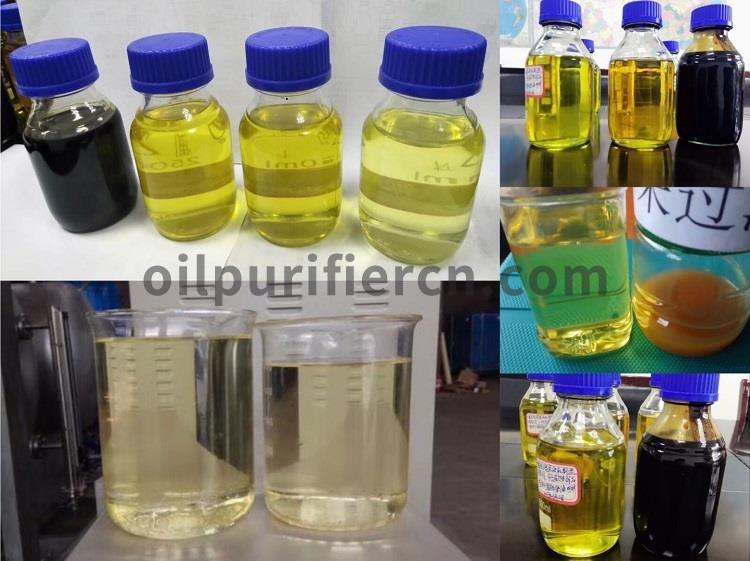
For a practical estimate, first identify the oil type, density, viscosity at the intended operating temperature, initial water content, particle contamination and final treatment objective. Then confirm the purifier’s recommended flow for that oil rather than relying only on the maximum nameplate capacity.
It is also necessary to determine whether the process is single-pass or multi-pass. If the machine is expected to remove water and gas as well as particles, ask for the operating conditions used for the stated dehydration performance, including temperature, vacuum level, feed rate and sampling method.
In general, a cleaner and lower-viscosity oil may be processed close to the equipment’s rated flow. Contaminated, emulsified or highly viscous oil may require a reduced flow and additional circulation. The most reliable answer to “how long does it take to filter one ton?” is therefore a conditional range based on the actual oil and the required quality, rather than a fixed time applicable to every vacuum oil purifier.
Address:No.66 Kecheng Road,Jiulongpo District, Chongqing, China
Phone:0086 13983031725
Whatsapp:0086 13983031725
Email:oilpurification@kaiqiancq.com